
Platform

The Enterprise Ontology

The Enterprise Ontology, built upon Onvisia’s Master Upper Ontology (MUO), creates a common semantic model for understanding the organization.

At its center is Relationship — connecting people, organizations, roles, processes, information, rules, agreements, authority, and purpose into a coherent representation of how the enterprise actually operates.

“Relationship is at the center.”

Back to Platform Discernment Assessment

The Three Core Capabilities of the Enterprise Ontology

1

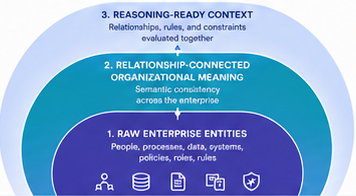
Relationship-Centered Model

  • Connects entities through meaningful relationships.
  • Represents roles, responsibilities, authority, and obligations.
  • Links people, processes, policies, data, and organizational structures.
  • Preserves context across organizational boundaries.
2

Shared Organizational Meaning

  • Establishes a common vocabulary across systems and functions.
  • Resolves differences in terminology and data structures.
  • Creates semantic consistency across enterprise information.
3

Context for Reasoning

  • Gives AI an understanding of how facts relate to one another.
  • Provides organizational context before reasoning occurs.
  • Enables relationships, dependencies, and constraints to be evaluated together.

Why It Matters

  • Beyond isolated data
  • Relationship is the key
  • Meaning before reasoning
  • Shared understanding across the enterprise
  • Better AI and human decisions
From raw enterprise entities through relationship-connected organizational meaning to reasoning-ready context

Deeper dive from the platform. You’re viewing the detailed breakdown of the Enterprise Ontology introduced on the Platform page.

Back to Platform

Turn Organizational Complexity into Shared Understanding

Enable AI and people to reason over a coherent, relationship-centered model.

Back to Platform Discernment Assessment